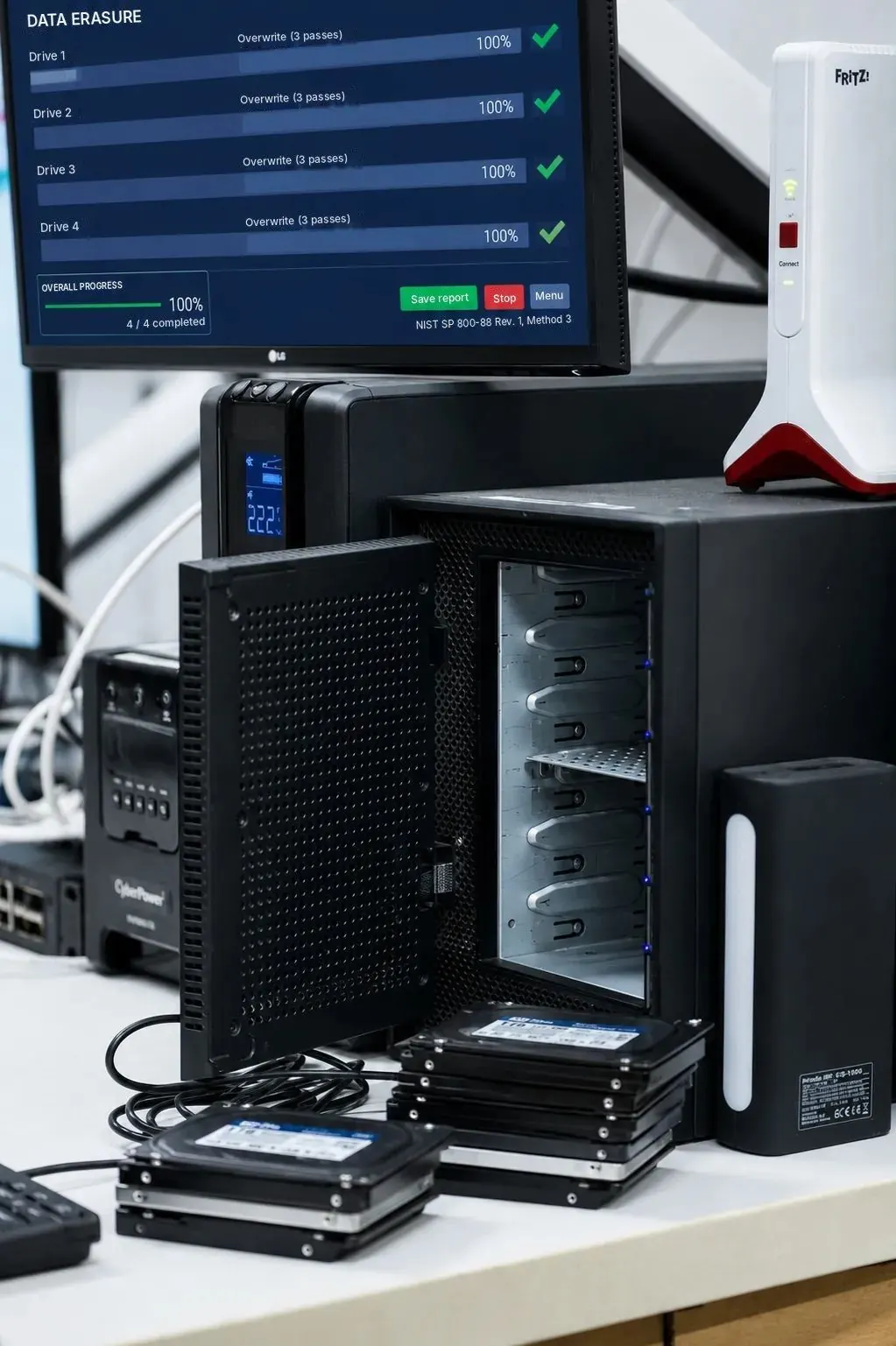
NIST Special Publication 800-88, Guidelines for Media Sanitization, is published by the US National Institute of Standards and Technology. Although it is a US document, it is used worldwide, including across the GCC, as the reference for how to make data on storage media unrecoverable. Revision 2 was published in September 2025, replacing Revision 1 from 2014.
The three levels: Clear, Purge and Destroy
| Level | What it does | Typical methods | Device reusable? |
|---|---|---|---|
| Clear | Protects against simple, non-invasive recovery | Overwriting all user-addressable storage with software | Yes |
| Purge | Makes recovery infeasible even with laboratory techniques | Firmware sanitise commands, cryptographic erase, block erase; degaussing for magnetic media | Usually yes (not after degaussing) |
| Destroy | Makes recovery infeasible and the media unusable | Shredding, disintegrating, pulverising, incinerating | No |
The right level depends on how sensitive the data is and what will happen to the device next. Devices leaving your control for resale generally call for Purge or Destroy.
Why SSDs need different treatment
Hard drives write data to predictable locations, so overwriting every sector works well. SSDs do not: wear-levelling and spare capacity mean some data sits in cells that normal software cannot address. That is why, for SSDs and NVMe drives, sanitisation relies on the drive’s own sanitise and cryptographic erase commands, followed by verification. Degaussing does not work on SSDs because they do not store data magnetically.
What changed in Revision 2
Revision 2 keeps Clear, Purge and Destroy, but shifts towards how an organisation runs a sanitisation programme, rather than listing techniques for each media type. For technique-level detail it points to the IEEE 2883 standard for storage sanitisation. It also places more weight on verifying results and on records such as certificates. For buyers of ITAD services, the practical message is the same: ask for the method used per device, proof of verification, and a certificate.
Is multi-pass overwriting needed?
No. The idea that a drive must be overwritten many times dates from much older hardware. NIST guidance does not call for multiple passes on modern drives; a single verified pass, or the drive’s own sanitise command, is the accepted approach.
What a proper erasure record contains
- Device and drive serial numbers
- Media type and capacity
- Method and level (Clear, Purge or Destroy)
- Verification result
- Date, location and operator
See our guide to certificates of data destruction for a full example.
Need this done for you?
Gulf Asset Services buys used IT across the GCC and destroys the data on every device, with a certificate per serial number.
Get a quote in 24 hours