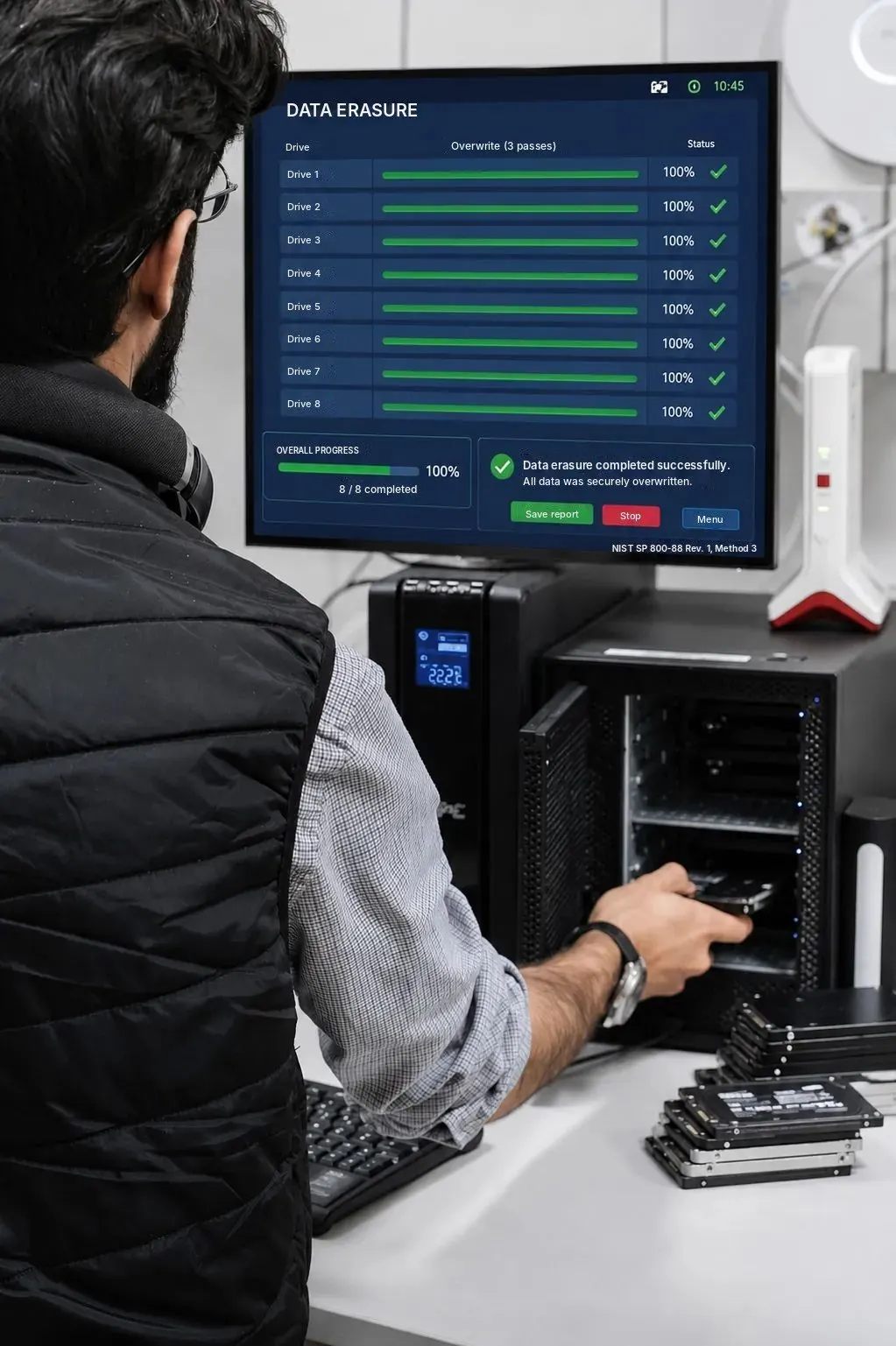
ITAD stands for IT asset disposition. It is the process of retiring IT equipment, such as laptops, desktops, phones, servers, storage and networking, in a way that is secure, documented and as valuable as possible. A good ITAD process answers three questions for every device: was the data destroyed, where did the device go, and what was it worth?
What ITAD covers
- Collection and chain of custody. Equipment is collected under seal and logged at every hand-off, so nothing goes missing between your site and the processing facility.
- Data destruction. Every storage device is erased with verified software or physically destroyed, and each result is recorded against the device’s serial number.
- Value recovery. Devices that still work are tested, graded and resold. Parts such as memory, processors and drives are harvested from the rest. The value comes back to you as payment or a revenue share.
- Recycling. What cannot be reused goes to licensed recyclers, who recover metals and plastics and handle hazardous parts such as batteries.
- Reporting. You receive certificates and a report showing what was collected, what happened to each item, the value paid and the environmental impact.
ITAD, IT buyback and e-waste recycling: the difference
The three terms overlap, but they are not the same.
| Main goal | Data destruction | Who it suits | |
|---|---|---|---|
| IT buyback | Get paid for used equipment | Should be included, but check | One-off refreshes and clear-outs |
| E-waste recycling | Recover materials responsibly | Not always included | Equipment with no resale value |
| ITAD | Retire IT securely, recover value, prove it | Always, with certificates | Organisations that retire IT regularly or have compliance duties |
In practice, a full ITAD provider does all three: it buys what has value, destroys data on everything, and recycles the rest.
Why ITAD matters in the GCC
Every GCC country now has a personal data protection law, and most require personal data to be disposed of securely when it is no longer needed. A laptop handed to an informal buyer with its drive intact is a data breach waiting to happen. ITAD gives you the evidence, a certificate per device, that your data was destroyed. Our guide to GCC data protection laws lists the laws country by country.
Environmental rules are tightening too. The UAE’s Federal Law No. 12 of 2018 on integrated waste management, and emirate-level rules such as Dubai’s Law No. 18 of 2024, expect waste to go through licensed operators. ITAD documentation shows where your e-waste ended up.
How an ITAD job works
- Inventory. You share a list of equipment, or the provider audits your site.
- Quote. A price per device for resaleable items, and the cost, if any, of services such as on-site shredding.
- Collection. Sealed transport, or on-site data destruction first if your policy requires it.
- Processing. Intake by serial number, testing, data destruction, grading.
- Settlement. Certificates, a full report and payment.
What to ask an ITAD provider
- Which data destruction standard do you follow, and do you verify each erasure? (Look for NIST SP 800-88. See our NIST 800-88 guide.)
- Do I get a certificate per device, with serial numbers?
- Can you destroy data on site if my policy requires it?
- How do you price, and will I see the price per device?
- Which licensed recyclers do you use for what you cannot resell?
- What happens if the audited count differs from my list?
Need this done for you?
Gulf Asset Services buys used IT across the GCC and destroys the data on every device, with a certificate per serial number.
Get a quote in 24 hours